
Venango Projected and Actual Release
A projected date is an estimate or calculated milestone before release occurs. It can reflect a minimum sentence date, a statutory early-eligibility date, a planned discharge, or an agency calculation. The actual release date records the completed custody event. Those labels cannot be exchanged. A court order may authorize release, while prison staff still must clear other cases, warrants, detainers, and processing steps.
Pretrial custody is even less fixed. A person awaiting adjudication in Venango County Prison may leave after bail is satisfied or a judge issues an order, but there is no sentence endpoint to calculate. A county-sentenced person has minimum and maximum terms. A state prisoner has sentence records and possible Board review. Each path needs its own source.
“Released from Venango County Prison” also may mean transfer. If PA DOC's current-inmate locator then shows a state institution, county custody ended but community release did not occur. The destination field in the prison movement record resolves that point.
Find a Venango Projected Release
Start with the last known custodian and sentence. The public PA DOC interface found during research does not expose a current-inmate projected or tentative release-date field. Its Department Supervised Individual mode can show an actual Release Date after institutional release. Advertising that actual field as a projection for someone still confined would be wrong.
- Determine whether the person is pretrial, county sentenced, or in PA DOC custody. Check all known Venango court dockets.
- For a pretrial person, review bail and court orders, then ask Venango County Prison about current custody. Do not calculate a date.
- For a county sentence, obtain the sentencing order, minimum and maximum terms, custody credit, and any later order from UJS or the Clerk.
- Ask Venango County Prison or Court Supervision Services for the controlling county information and whether another hold prevents release.
- For a state sentence, use PA DOC's current-inmate locator for custody, then obtain the sentence-status record or Board Action when controlling dates are needed.
- After release, check the Department Supervised Individual mode for an actual Release Date and district office, then confirm the event through the custodian.
A named-person custody and records workflow also appears on the Venango County released-inmate search. It adds PA SAVIN, court, federal, and transfer checks when the last custodian is unclear.
Note: A public locator miss should be recorded as a no-match for the search used, not as proof that no sentence or release record exists.
Venango Sentence Dates and Credit
Pennsylvania does not use a general rule requiring an ordinary state prisoner to serve 85 percent of the maximum before parole. The Pennsylvania parole process says that claim is false. Federal good-conduct rules must not be imported into a Venango county or Pennsylvania state calculation.
Under 42 Pa.C.S. Chapter 97, an ordinary total-confinement sentence has minimum and maximum terms. Section 9756 generally limits the minimum to no more than half the maximum. The minimum is usually the first point at which parole may be considered, not a set release date. Section 9760 addresses credit for custody tied to the charge or conduct. Credit disputes, resentencing, revocation, and concurrent or consecutive cases can alter the calculation.
Section 9762 helps allocate confinement between county and state systems. That matters because the decision maker changes with the sentence and legal authority. County parole can remain with the sentencing court under Section 9776 and local practice, while state parole rests with the Pennsylvania Parole Board under Title 61.
No 85% rule: Do not multiply a Venango sentence by a fixed percentage. Read the actual order, statutes, custody credit, and agency record.
Why Venango Release Dates Change
A date can move because the legal calculation or the conditions for exit change. Sometimes the date itself remains sound, but the person goes to another custodian rather than the community. Use the source label beside every date. A minimum date, Board decision date, alert time, and physical release time represent different events.
| Factor | Effect on release | Source to check |
|---|---|---|
| Custody credit | Changes credited time against minimum and maximum terms. | Sentencing order, Section 9760 record, and sentence-status calculation |
| Another case or hold | Can prevent community release even when one case reaches an endpoint. | All UJS dockets and the prison movement record |
| Parole decision | Grant, denial, or added conditions can change the expected path. | Board Action or county court order |
| Home plan | A favorable state decision may wait for an approved residence and other checks. | PA DOC home-plan status and parole office |
| Revocation or resentencing | A new order can recalculate or extend custody. | Court docket, Board record, and DOC sentence record |
| Transfer | Ends Venango custody without ending government custody. | County movement record and receiving-agency locator |
DOC says an in-state home-plan investigation typically can take up to 45 days. That is a planning estimate, not a universal waiting period or release promise. Detainers, conditions, and processing may still matter after a favorable state Board decision.
Read Venango Release Date Labels
Several dates can appear in one case, and each carries its own meaning. The sentencing date marks when a term was imposed. A custody-credit period affects the sentence calculation. The minimum usually marks parole eligibility. The maximum is the endpoint of the imposed term subject to lawful credit, recalculation, revocation, and other cases. A Board Action date records a decision, not a jail-door event.
A court filing date can be later than the date an order was signed. PA SAVIN supplies an alert or event-update time. Venango County Prison's movement record can provide the effective release time. The Department Supervised Individual Locator may display an actual Release Date after the person enters supervision. Put the source label beside every date so a reader can see which event it describes.
- Minimum date
- The usual first parole-eligibility point, not a guaranteed release.
- Maximum date
- The sentence endpoint as lawfully calculated, subject to other active custody.
- Board Action
- The Pennsylvania Parole Board's person-specific decision document.
- Detainer
- A request or legal hold that can keep a person in custody for another authority.
- Actual Release Date
- The date an agency records completed institutional release, not a prior estimate.
A name match is not enough. Compare date of birth, inmate or parole number, case number, committing county, and location. Hyphens, suffixes, aliases, and spacing can split records. If two systems differ by a day or by several hours, preserve both timestamps and ask the physical custodian which one represents the effective exit.
Venango State Release and RRRI
The Recidivism Risk Reduction Incentive, or RRRI, is a distinct early-eligibility law for eligible state sentences. It is not automatic good time. Pennsylvania excludes specified offenses and circumstances. When a court imposes an RRRI minimum, the statutory measure is generally three-fourths of a minimum of three years or less, and five-sixths when the minimum exceeds three years.
The person must still meet program and conduct terms, receive DOC certification, and undergo Board review. The official RRRI explanation describes the path, while 61 Pa.C.S. Chapter 45 supplies the law. An RRRI minimum marks eligibility. It does not promise a street date.
The official RRRI page is shown below as the state source for this separate calculation.
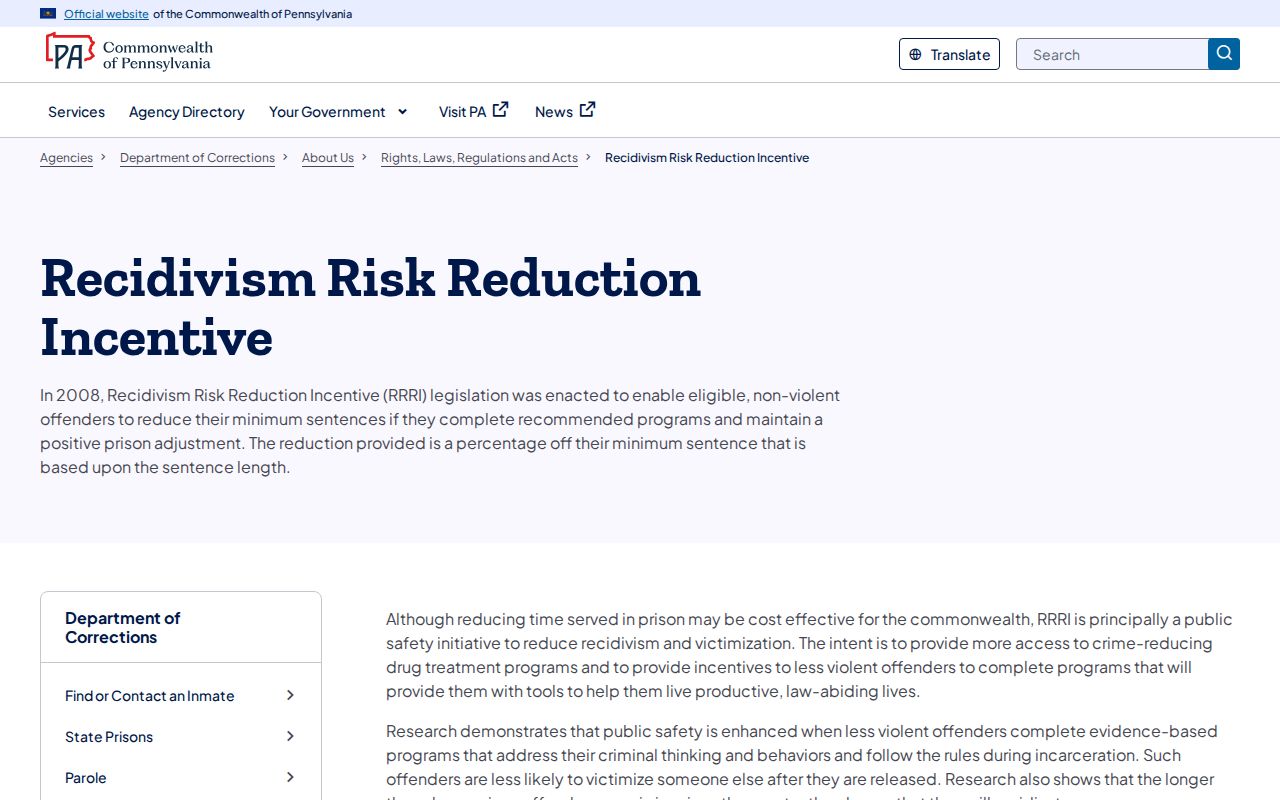
Any person-specific figure must come from the sentencing and DOC records, not from a generic percentage applied to the term.
Venango County Pre-Release Review
Venango's Pre-Release Advisory Board, or PRAB, meets every two weeks and reviews qualifying county-sentenced people who are nearing a minimum. The group may recommend release, more confinement, treatment, house arrest or electronic monitoring, and added conditions. It only recommends. The sentencing judge decides.
The meeting cycle is not a release schedule. A person can be reviewed and stay confined. Venango's Available Services information describes a local Earned Time component through community service that may reduce a county minimum, but no public conversion rate was found. Do not turn program participation into a number of credited days. Ask the prison, Court Supervision Services, or sentencing court for the credited minimum and controlling order.
The county's official PRAB source is shown below.
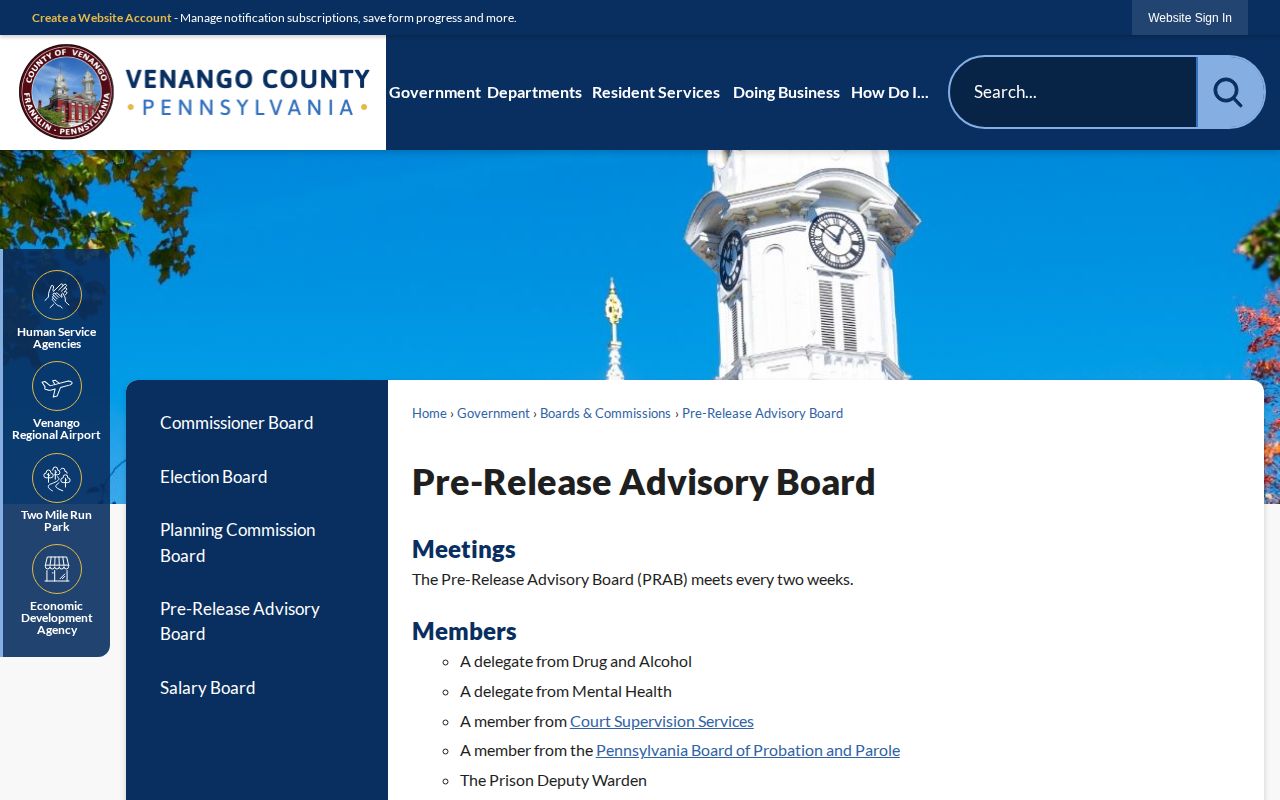
Its local review role is distinct from state RRRI and Pennsylvania Parole Board authority.
Note: The two-week PRAB meeting pattern does not establish when prison staff will complete any approved Venango County release.
Confirm a Venango Release Date
For a pending event, PA SAVIN/VINELink can send a release or movement alert tied to a participating record. Registration is person-specific, not a way to calculate the date. The Venango County VINELink inmate search explains how to match the record and register. An alert should be preserved with its label and time.
For county custody, Venango County Prison's existing movement or release record is the best formal source for the effective date, type, authority, and transfer destination. A UJS order explains why release became lawful but may predate the physical exit. For state custody, the supervised-person locator can show an actual Release Date after update, while a DOC record or parole office can confirm the event.
When sources differ, report both labels and timestamps. Ask the agency that maintains the release record which entry represents physical discharge. This preserves the difference among eligibility, authorization, processing, transfer, and completed community release.
For a formal county record, request existing commitment, movement, release date and time, release type, authority, and transfer destination through Venango's Right-to-Know process. For state custody, request the existing DOC sentence-status or release record with the full name, inmate number, date of birth, and approximate date. A focused request avoids asking an agency to create a new projection. Keep each reply.
Federal and immigration custody require separate checks. A BOP Release Date concerns the end of BOP custody and does not rule out supervision or another hold. ICE's locator tests current immigration custody, not a historic Venango release date. Use those systems only when the case or movement record points to that custody layer.
A records response should be checked field by field. If it supplies booking and discharge dates but omits the type, authority, or destination, ask whether that data was redacted, not maintained, or kept in another record. Preserve the response and any appeal instructions.